Free Reference · Evidence Synthesis
Still Googling what I² means
at eleven at night?
A plain-language handbook of the pooling, heterogeneity, robustness, publication-bias, and certainty methods used in modern evidence synthesis — one concept per page, formulas only where the formula is the idea. Free PDF, straight to your inbox.
Get the handbook
53 concepts across 12 parts, from the raw ingredients of a pooled analysis to the certainty rating that sits on top of it. Leave a work email and the PDF downloads immediately.
One page, in full
Every concept follows the same shape: the nutshell, the maths, what it cannot do, how it's used in practice, and a kitchen-table analogy. Here is the very first page.
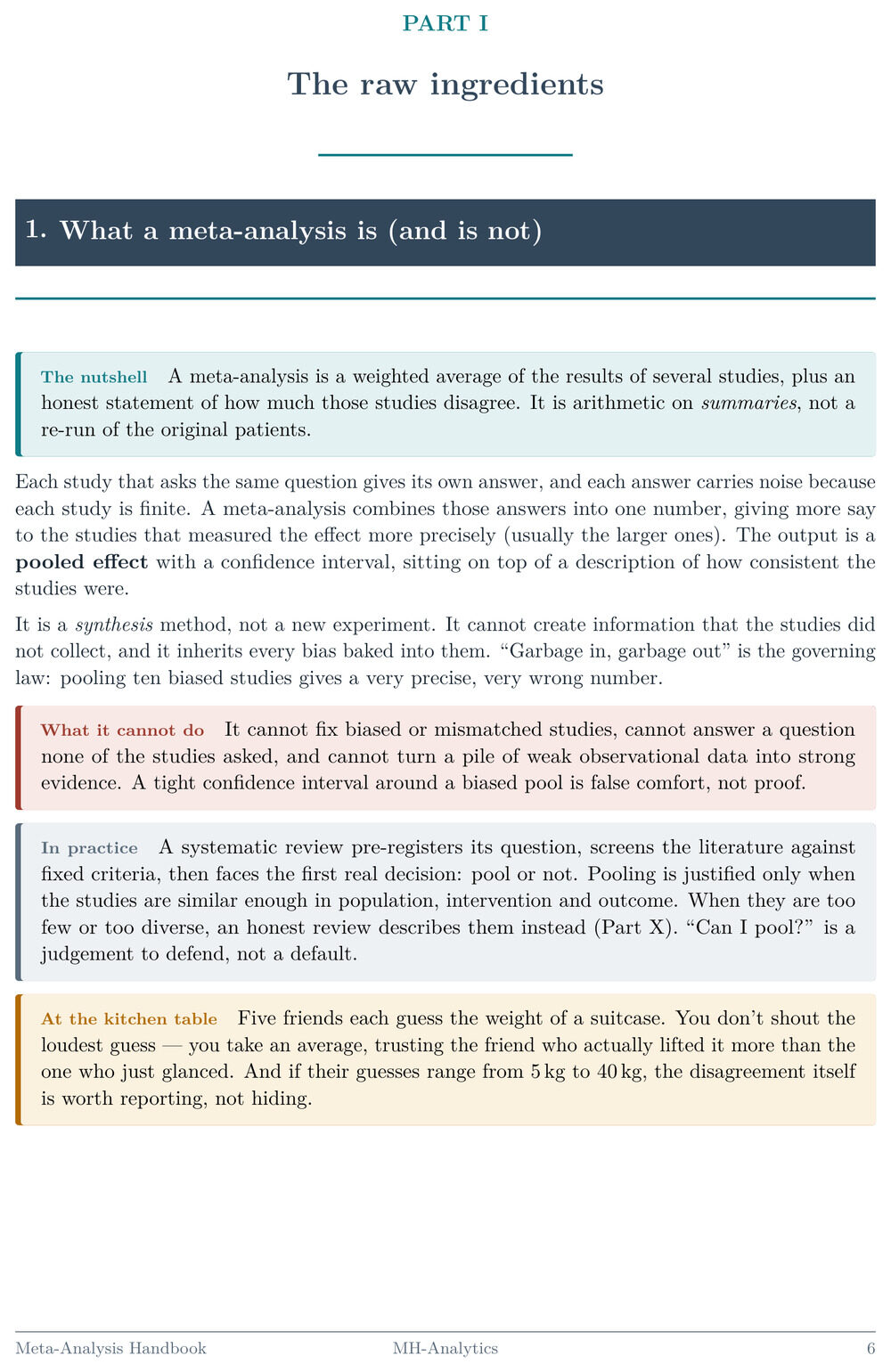
Built for read → rewrite → explain-to-a-layperson
Every page is designed for the same learning loop: read one concept, close the book, rewrite it from memory, then try to explain it to someone with no background at all.
The maths, only where it's the idea
Every formula is glossed symbol by symbol in plain words. No code, no derivations for their own sake — just the working idea, written down.
What it cannot do
Every method gets an honest limits section. Knowing when a method fails is treated as seriously as knowing what it shows — that's the difference between reading about a method and understanding it.
In practice
How the method is actually used, what to report alongside it, and the values or rules of thumb to expect — the part a textbook derivation usually skips.
At the kitchen table
An everyday analogy for every concept, for the last step of learning something: explaining it to someone with no background at all.
Twelve parts, fifty-three concepts
From effect sizes and pooling models through every heterogeneity diagnostic, sensitivity check, publication-bias test, special data structure, and certainty rating — one concept per page, read straight through or jump to one.
A field guide to twelve mistakes
The closing page distills the whole handbook into twelve mistakes that have each sunk a published meta-analysis — the one page worth reading even if you read nothing else.
The twelve parts
- The raw ingredients
- The pooling model
- Heterogeneity — how much
- Heterogeneity — where from
- Robustness & sensitivity
- Explaining heterogeneity with covariates
- Small-study effects & publication bias
- From estimate to claim
- Certainty & risk of bias
- Descriptive synthesis & when to stop
- Special data structures
- Closing field guide
Read the walkthrough first
Want to see how one concept plays out on the page before downloading? Read the companion blog post, or reach out for help applying any of this to a review already underway.
Questions? Call +49 1515 79 43 500 or write to marc.harms@mh-analytics.eu.